 +91 8981168001
  info@digihyfy.com
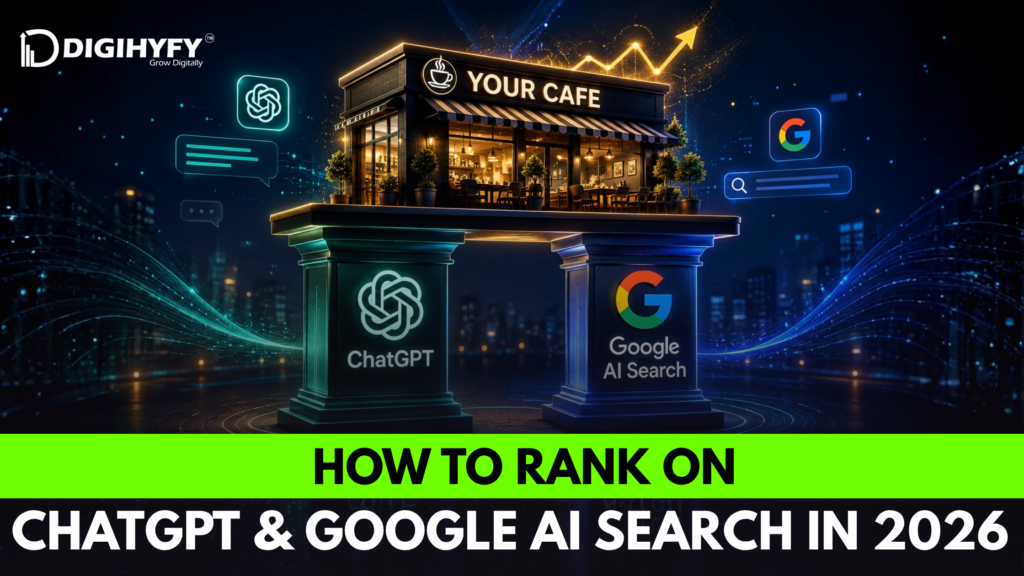
The pace of changes in the world of search is increasing. By 2026, there is no longer dependence on Google search results only. Millions of people start asking their questions straight to ChatGPT, Google AI Overviews, Gemini, and other AI-based search engines. There is a new digital marketing opportunity that has emerged called AI Search Optimization.
Being ranked on Google is not enough for the business. The website needs to be not only visible in the search results but also mentioned and cited in AI search results. Being listed in the results of AI-powered searches, one can increase his visibility and credibility and attract more qualified traffic.
In this guide, we will look into how to rank on ChatGPT and Google AI Search in 2026 following the rules of the future SEO. Google itself says that there are some SEO fundamentals that are still needed to be visible in AI-powered search results.
What Is AI Search Optimization?
AI Search Optimization refers to optimizing the creation and organization of information for AI-based search engines to interpret and cite in their search results. AI SEO goes beyond the traditional SEO approach in ensuring the content is referenced directly in the AI-based answers.
AI search engines, unlike traditional search engines, do not display links; rather, they provide an answer to the user’s query directly. Therefore, your objective should be to become a credible resource cited in AI answers.
Why Ranking in AI Search Matter
Google AI Overview and ChatGPT Search are revolutionizing the way people search for information on the web. AI answers have now become an integral component of the search process, usually coming up before the normal search results.
Advantages of ranking in AI search include:
- Improved brand visibility
- Increased authority and credibility
- Targeted traffic to your site
- Lead generation capabilities
- A competitive edge in your industry
Those businesses that adopt early will get a strong edge over their competitors who are stuck in old-school SEO
- Create Helpful and Original Content
AI looks to promote those pieces which are truly valuable. Do not rewrite articles, rather share unique ideas, experiences, cases, opinions.
Google advises to create people-oriented content that would be valuable and have a unique point of view.
There are some types of content that work effectively:
- How-to guides
- Case studies
- Interviews
- Research articles
- Tutorials
The more valuable your content is, the better for its references by AI systems.
- Focus on Topical Authority
Publishing just one blog post is no longer enough for AI algorithms. Websites need to showcase their authority on the whole topic, not just individual blog posts.
If, for instance, you are running a business which offers digital marketing services, try publishing content clusters in the following categories:
- SEO
- Content Marketing
- PPC Advertising
- Social Media Marketing
- AI Search Optimization
- Local SEO
When multiple high-quality articles cover related subjects, AI engines are more likely to view your website as an authoritative source.
- Optimize for Conversational Search Queries
Users utilize ChatGPT in a different way from how they use regular search engines. Rather than entering keywords into the search engine, users ask full questions.
Examples:
- “How do I increase my website visibility through AI searches?”
- “What are the best AI SEO techniques in 2026?”
- “How does the AI of Google Overview select its sources?”
Provide information that will help to answer those questions. Provide headings and frequently asked questions that can be extracted by AI.
- Improve Technical SEO
Technical SEO is still very important for AI visibility. Search engines should be capable of crawling and comprehending your content.
Main technical aspects are:
- Good page load speed
- Mobile optimization
- Website with https
- Clear site structure
- Xml sitemap
- Correct internal links
Google insists that content that can be crawled and accessed is crucial for being visible in the generative AI experience.
- Use Structured Data and Clear Formatting
Well-structured content is much easier for AI algorithms to comprehend.
Some of the best practices to follow are:
- Utilize H1, H2, and H3 headings
- Implement FAQ schema
- Incorporate bullet points and numbered lists
- Develop summaries
- Apply title tags
Structured data, although not a ranking factor for AI-powered search engines, helps search engines to comprehend your content better.
- Build Brand Authority Across the Web
In addition to assessing your site, AI tools will also assess your entire online reputation.
Boost your authority by:
- Trade Publications
- Blogging
- PR Campaigns
- Testimonials
- Social Media Interactions
- Contributions from experts
Good mention of your brand or authoritative references will help you get mentioned by AI-powered search engines.
Final Thoughts
The future of search no longer lies in the conventional Google search result pages. With artificial intelligence platforms becoming the main sources of information for people, companies need to adjust their digital marketing efforts accordingly.
For companies to succeed in 2026, it will not be enough to do SEO optimization alone. You will need to complement the process with AI Search Optimization where you create quality content, answer queries clearly, optimize technical SEO and build trust online to get on ChatGPT answers, Google AI Overviews, and many other AI search platforms.
By doing this now, you will have a brighter future ahead of you.