 +91 8981168001
  info@digihyfy.com
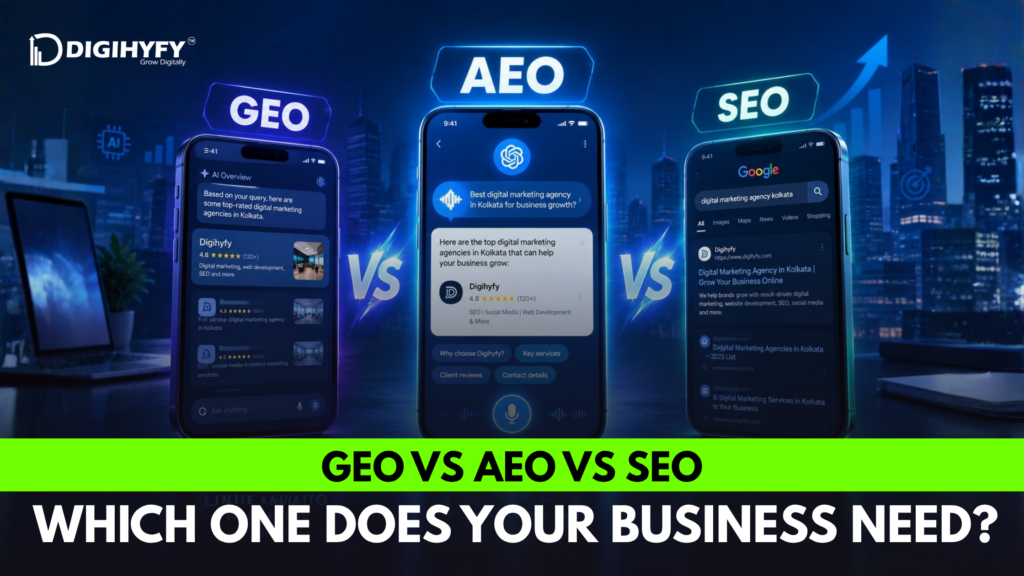
There are rapid changes happening in digital marketing. In the past, companies would pay more attention to SEO (Search Engine Optimization) in order to rank their sites on Google.
However, due to advancements in the fields of artificial intelligence and AI-powered search, two new terms have emerged, which are GEO (Generative Engine Optimization) and AEO (Answer Engine Optimization).
Nowadays, people don’t just search on Google but also ask their queries on AI platforms and seek an answer rather than visiting many websites.
It is crucial for companies to understand the distinction between SEO, AEO, and GEO.
What is SEO?
SEO stands for Search Engine Optimization which is the conventional way through which one can improve their website’s visibility on search engines like Google and Bing.
The core objective of SEO is to ensure that your website shows up high in the organic listings of the search engine when people type in specific keywords.
For instance, if you search “best digital marketing agency in Kolkata,” SEO will be a strategy aimed at ensuring your website shows up high in Google’s listing.
Typical areas covered by SEO include:
- Keyword research
- Website optimization
- Quality content
- Technical SEO
- Backlinking
- Page speed and mobile experience
- Local SEO and Google Business Profile
SEO is still relevant since search engines still drive a lot of traffic to business websites
What is AEO?
AEO, or Answer Engine Optimization, refers to optimizing your content so that you can be able to give a direct answer to your reader’s questions.
Unlike SEO which focuses on keywords, AEO looks at search intent and question-based queries.
For instance, a user may ask:
“What does a digital marketing agency do?”
With AEO, an article will clearly answer the question and it will be in such a way that search engines will be able to easily interpret and feature it.
The AEO strategies include:
- Writing FAQ articles
- Giving specific answers to specific questions
- Using proper headings
- Writing concise definitions
- Having a logical structure
- Understanding user search intent
- Using structured data when necessary
The aim here is to ensure that your content is easy to read and interpret for the search and answer engines.
What is GEO?
GEO stands for Generative Engine Optimization and is one of the new methods which aims to increase the probability of accurate representation or mentioning of a brand by an AI in its answers.
The AI search and AI assistants are able to aggregate information from different sources before giving the answer to a user.
For instance, a person asks an AI device the following question:
“Which digital marketing agencies will promote my company in Kolkata?”
Instead of presenting users with a usual blue link result, AI creates a summary and mentions some companies in its answer.
GEO is aimed at making the information about your brand understandable, reliable, relevant, and credible for the AI.
Some important elements of GEO include:
- Authoritative content
- Brand mentions on trusted sites
- Topical expertise
- Accurate business data
- Valuable and unique content
- Entity and brand information
- Reputation and reviews
GEO vs AEO vs SEO: What’s the Difference?
While these three methods serve different functions, they are all very related to each other.
SEO mainly revolves around the improvement of visibility in search engine results.
AEO revolves around the visibility of content being recognized as a helpful response to particular questions.
GEO revolves around visibility and representation in generative AI experiences.
It’s like this:
SEO = Get Found
AEO = Get Answered
GEO = Get Mentioned
But again, these methods should not really replace one another.
Which One Does Your Business Need?
It is neither SEO vs AEO vs GEO, but rather, SEO & AEO & GEO for the majority of businesses.
An effective digital strategy begins with having a technically sound, valuable, and trustworthy website. SEO aids in getting discovered by individuals. AEO assists in ensuring that the provided information answers certain queries in an effective manner. GEO aids in boosting the visibility of the brand through AI search discovery.
For instance, a local business can create location-based service pages through SEO, incorporate FAQs through AEO, and create expertise-based content for the brand.
Final Thoughts
There have been changes in search behavior. Users are using the old-school search engines, voice assistants, AI technology, and conversational search to find business information.
It is time that the business owners stopped focusing only on optimizing their websites with the help of keywords.
While SEO can help you in building your search presence, AEO can help in becoming the direct answer and GEO can help you in increasing your search visibility through AI-based searches.
The businesses that emphasize quality content, expertise, accuracy, and online presence will be able to adapt to the new trends in the field of search.
Thus, instead of wondering,
“GEO vs AEO vs SEO which one should I choose?”
businesses should consider how all three can work together to build long-term online visibility and attract customers wherever they search.