 +91 8981168001
  info@digihyfy.com
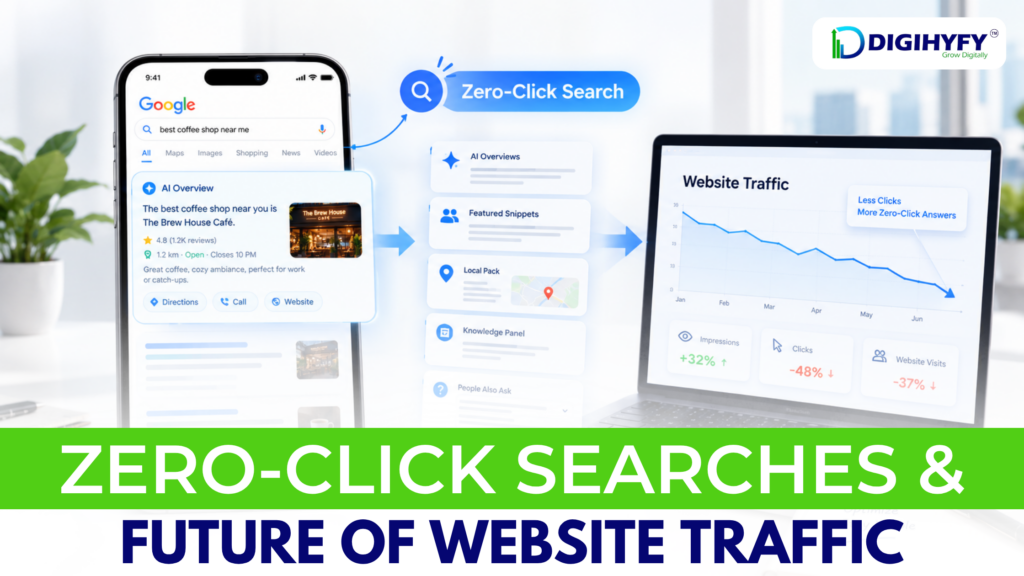
The search engine industry has undergone massive changes in the last couple of years. Gone are the days when you had to go to a website each time you searched for something online. Today, you get answers right from the search results through featured snippets, knowledge panels, maps, FAQs, summaries from artificial intelligence, and many more search features. This is referred to as zero-click search.
This is a double-edged sword in that even though there will be reduced clicks on the traditional organic listings, companies can leverage visibility in the search results.
What Are Zero-Click Searches?
Zero-click searches are performed by users who find everything they need on the page where the results are displayed.
For instance, a person looking for “weather in Delhi” may get the forecast right away. Also, a query like “how many calories are in an apple?” may yield an instant result on the results page.
The main function of search engines is to provide information to users easily and quickly. As search technologies improve, people receive answers even before going to particular websites.
Why Are Zero-Click Searches Increasing?
A number of factors are contributing to the development of zero-click searches.
Firstly, the search engines have started adding more SERP features that directly provide the answer. Featured snippets, local packs, images, calculators, and knowledge panels all contribute to making website click unnecessary.
Secondly, there has been the development of mobile search, which means that people use their smartphones while searching and do not necessarily want to conduct in-depth research.
Thirdly, the development of AI search is also a very significant factor. Search platforms now understand the question, gather the information and summarize the answer within the search engine itself.
This means that rankings and clicks are no longer the only metrics for SEO success.
How Zero-Click Searches Affect Website Traffic
The major issue that website owners should consider is the decrease in clicks from organic sources. When the search engine answers a question, users will have no reason to click through to the website.
Such an issue becomes especially relevant for keywords of informational character like “what is,” “when,” “how much,” or “definition” type of queries.
Nevertheless, it does not automatically mean that zero-click visibility means zero value of a business. The brand that ranks well in the search results may become better known and establish itself as a credible source.
Thus, the approach to SEO should not be limited to just clicking on links.
How to Adapt Your SEO Strategy
Companies will need to adapt themselves to the new reality of search.
- Make the Content Visible to Searches
Make sure that your content is eligible to be placed into featured snippets, FAQs, local search results, etc. Use proper headings, short and accurate answers, structured data, and keywords.
- Choose Keywords That Carry More Intent
Not all keywords are created equal – some of them bring visibility but no clicks, others – potential visitors of a company’s site.
Such keywords include product comparisons, service searches, pricing queries, and solutions.
- Establish Credibility Through Your Brand
As more answers come directly from the search engine, you need to establish yourself by providing valuable information such as unique research, insights, case studies, and resources to prove your authority and expertise.
Being a recognizable brand may motivate users to perform an exact search of your company rather than using general keywords only.
- Provide More Than Just Answers
If all your page does is to give an answer within two sentences, then users will have no need to click.
So give them a reason to keep on reading by adding things like examples, step-by-step processes, statistics, experts’ explanations, visuals, comparisons, and recommendations.
- Track More Than Organic Traffic
Website traffic is important but should not be the sole metric for SEO. Other metrics that companies should keep track of include impressions, branded searches, search visibility, conversions, engagement, and leads.
A page may receive a low number of clicks but provide immense brand visibility and conversions.
The Future of Website Traffic
Zero-click searches will continue to be a part of the search world for a long time to come. With the advances in the ability of search engines and AI applications to understand user intent, the search results will serve information to users in increasing amounts.
This doesn’t imply that websites will become useless. The function of websites is going to change. Websites will have to provide information, expertise, experiences, tools, products, and other resources to users that cannot be achieved through a mere search result.
Conclusion
Zero click searches have introduced a new way to access information from the web. Although such searches minimize the number of clicks on some types of queries, they have opened up new possibilities for companies to increase their visibility and showcase their competence.
Rather than oppose zero click searches, it would be wiser for organizations to adapt to them by leveraging search optimization, targeting lucrative keywords, establishing brand authority, and producing content of higher value.