 +91 8981168001
  info@digihyfy.com
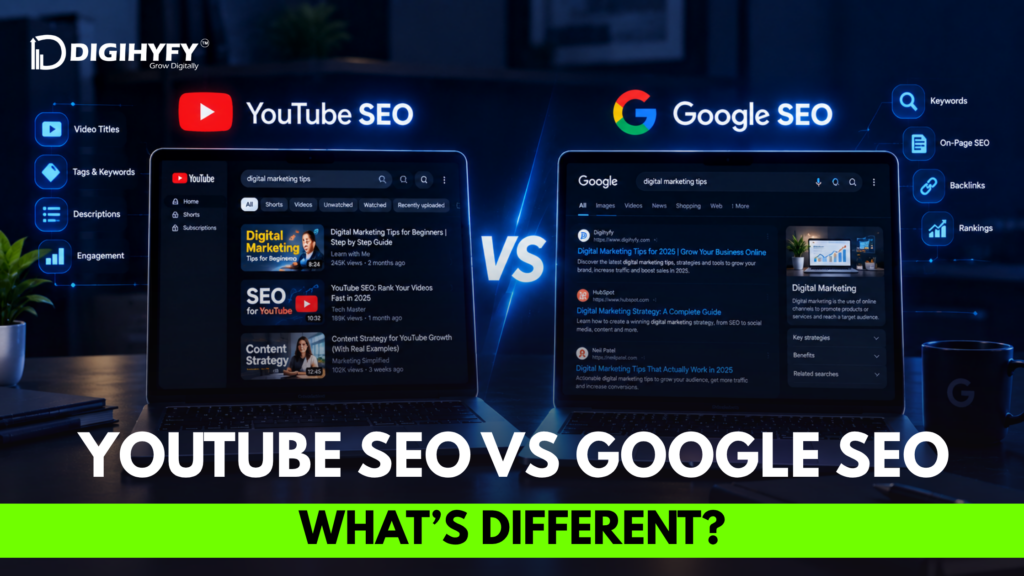
Search Engine Optimization, or simply SEO, is a crucial component of digital marketing. This is the method through which businesses and content creators manage to get their message across to many people via the internet. Yet, there is a great deal of variation when it comes to SEO.
Google SEO and YouTube SEO differ greatly in purpose, strategy, and criteria for ranking. The former applies primarily to websites while the latter applies to video content.
What Is Google SEO?
Google SEO is the optimization of a web page or website to help it rank well in Google search results. Whenever users look for something in Google, they use several criteria to determine which webpages are more relevant to show at the top of their results.
Some of the things that Google SEO involves include:
- Keyword analysis
- Content creation
- Site speed
- Mobile optimization
- Backlinks
- Internal links
- Search intent
- Technical SEO
- User experience
For instance, when users look for the best digital marketing agency in India, Google displays various webpages such as blogs, service pages, business sites, etc.
The primary objective of Google SEO is to generate organic traffic to a website.
What Is YouTube SEO?
YouTube SEO is an effort to optimize videos to ensure they rank well on YouTube search results and recommendations.
YouTube is a search engine as well, but it only indexes video content. The signals it checks to rank videos are indicators of the usefulness and engagement of the videos to viewers.
The key factors for YouTube SEO are:
- Video Title
- Video Description
- Keywords
- Tags
- Video Thumbnail
- View duration
- Audience retention
- Likes and comments
- CTR (Click Through Rate)
- Engagement
- Channel Authority
When a user searches “how to do SEO for beginners” on YouTube, he or she will see videos ranked by their relevancy and usefulness to viewers.
The primary objective of YouTube SEO is to boost views and engagement on the videos.
YouTube SEO vs Google SEO: Key Differences
- Search Intent
Google can offer different results from articles, videos, images, news, maps, and even shopping results. YouTube, on the other hand, mostly offers video results.
In Google, someone might be looking for an in-depth article. In YouTube, the same person might want to see a video tutorial.
This is to mean that content must be in line with the platform and the search intent of the user.
- Ranking Factors
For Google, the ranking factors include backlinks, authority, content, technicality, and relevance.
In YouTube, viewer behaviors are very important for the ranking of your video.
It is therefore important to make an outstanding video just like it is important to optimize your video titles and descriptions.
- Keywords
The use of keywords is essential for both channels, but they are applied in different ways.
While keywords for Google SEO can be used in headings, URL, text, meta description, and other elements, the following places are typical when it comes to YouTube SEO: title of the video, description, spoken words, and even tags.
Keyword research is always to be performed according to what people search for.
- Format of Content
There are numerous formats supported by Google SEO. A website can publish blogs, landing pages, product pages, guides, etc.
YouTube SEO is mainly based on videos. It means that visual aspects, sound quality, story-telling, and editing become crucial factors here.
- User Engagement
User engagement is significant in both channels, but YouTube is highly dependent on users’ actions.
If users open a video but leave it after a few seconds, it means that their expectations were not met. A good start, valuable information, and proper structuring of the video can help to retain viewers.
Can You Use Both YouTube SEO and Google SEO?
Sure thing. In fact, utilizing both can improve your digital marketing efforts.
A blog post can be directed toward Google searchers, and a YouTube video about the same subject can be directed toward those who search on YouTube for videos.
One can then embed that video on the blog, direct one’s website through YouTube, and market the same topic on social media platforms.
For instance, a digital marketing company could produce a blog named “How to Improve Local SEO” and a YouTube video about the same topic.
Which SEO Is Better?
There is no outright winner; it all depends on your business objectives and target market.
Google SEO is great for websites, blogs, services pages, and businesses that want constant organic traffic to their website.
YouTube SEO works well for people, businesses, and brands who can articulate their message through video.
Many businesses find success in utilizing both strategies at once.
Final Thoughts
SEO of YouTube and SEO of Google serve a common objective – to make useful content findable for users. Nevertheless, their ranking and optimization algorithms differ from each other.
Google relies primarily on relevance, content quality, website authority, and site performance. YouTube considers relevance of videos and user behavior metrics such as clicks, views, watching duration, and engagement rate.
In order to have a sustainable presence online, stop treating YouTube and Google as competitors. Combine their efforts. A comprehensive SEO approach that will include both website content and YouTube videos will allow reaching a wider audience, building authority, and increasing traffic.