 +91 8981168001
  info@digihyfy.com
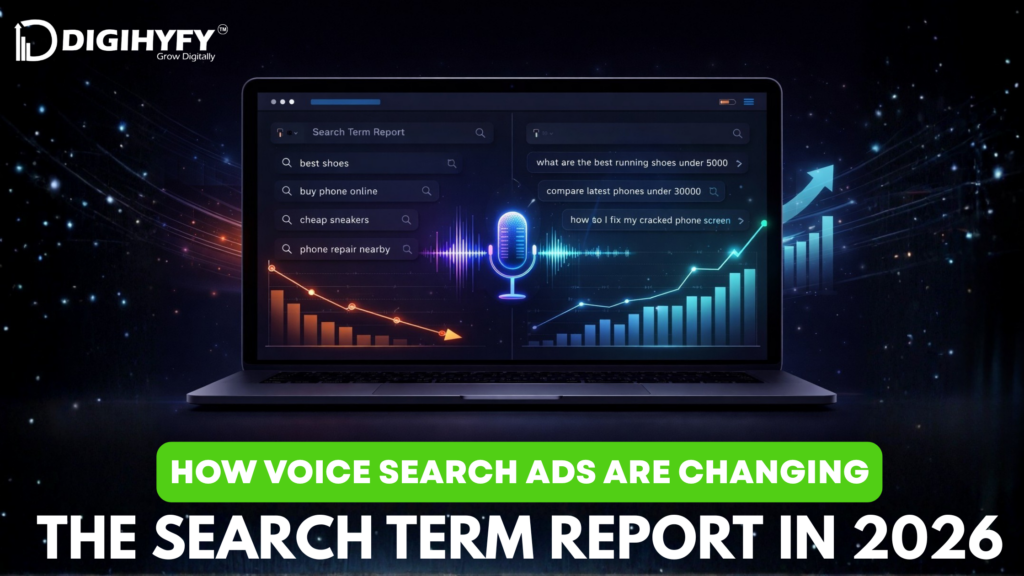
Voice search is no longer considered a futuristic concept but rather an integral part of how people interact with search engines. Due to the rapid rise of voice assistants and AI-powered devices, voice search has become one of the most significant factors affecting how advertisers analyze their ad campaigns. One of the most significant areas of voice search affecting advertisers is the Google Ads Search Term Report.
The Search Term Report, or STR, has undergone significant changes by 2026, unlike what marketers were used to just a few years ago. Today, marketers are no longer used to short phrases but rather long phrases, thanks to voice search.
In this blog, we will be discussing how voice search ads are affecting the search term report and what marketers should do to adapt to this change.
- Shift from Keywords to Conversations
Traditionally, search queries are short and direct, such as “best shoes” or “digital marketing agency.” However, with the use of voice search, this has changed completely.
Today, users are searching with complete sentences such as:
“Which is the best digital marketing agency near me for small businesses?”
Voice searches are long and natural. In fact, voice searches are 3-5 times longer than traditional searches
Impact on Search Term Report:
- STR now has long-tail queries and conversational queries
- Keywords no longer match search terms
- More variation in search query format
This means marketers must look beyond keywords and focus on intent and natural language.
- Rise of Natural Language & Semantic Matching
Voice search heavily depends on Natural Language Processing (NLP). Google no longer looks for exact keywords but also interprets the meaning and intent of the search.
For instance:
Keyword search: “plumber near me”
Voice search: “Hey Google, my sink is leaking; can I find a plumber near me?”
Though the search terms differ, the intent is the same.
Impact on STR:
- More semantic matches instead of exact matches
- Broader and sometimes unexpected search terms
- Increased dependency on AI-driven targeting
According to recent insights, search is shifting from “syntax to semantics,” meaning intent matters more than exact wording
- Increase in Irrelevant or Low-Intent Queries
One of the major problems faced by advertisers today is the increase of irrelevant queries or low intent searches within the search term report.
Voice queries may contain:
- Hesitation searches
- Questions
- Exploratory searches
This has made it difficult to identify whether the consumer is ready to convert or not.
Impact of Voice Queries on STR:
- More irrelevant traffic
- More ad spend wastage
- More emphasis on filtering strategies
Advertisers are now forced to focus on negative keywords to avoid wastage of spend.
- Growth of Question-Based Queries
Voice search queries are mostly question-based. Users tend to ask:
“What is the best salon near me?”
“How much does digital marketing cost?”
These types of queries have never been seen before in search behavior.
Impact on STR:
- Increase in ‘who, what, where, why, how’ queries
- Increase in opportunities for content-based ads
- Ad copy must be aligned with user queries
Queries have a high probability of getting answered through ads.
- Stronger Local Intent Signals
Voice search is highly dependent on local searches, and most voice searches are related to local searches.
For example:
“Find a bakery near me open now”
Research has shown that a huge percentage of voice searches are related to local searches, and most of them are followed by actual visits within 24 hours.
Impact on STR:
- Increase in voice searches related to “near me” and location-related searches
- Higher conversion potential for local businesses
- Significance of optimizing Google Business Profile
Businesses need to focus on local SEO + PPC.
- Emergence of Long-Tail and Intent-Rich Data
Voice search has opened up a new dimension of intent-rich data. Unlike keywords used in other search engines, voice search reveals:
- User problems
- Urgency
- Contexts
For example:
“I need a doctor right now due to severe back pain”
It offers a deeper understanding of customers’ needs.
Impact of STR:
- Improved understanding of customers’ behavior
- Improved target audience
- Ability to develop targeted marketing campaigns
The marketer who understands long queries will have an edge over the competition.
- Increased Complexity in Campaign Optimization
In light of these developments, it has also become more complicated to manage campaigns.
Key Challenges:
- Matching long information queries with short keywords
- Dealing with irrelevant traffic
- Managing different types of intent optimization
Actions to be taken:
- Carrying out STR analysis on a regular basis (weekly or even daily)
- Utilizing broad match + smart bid strategy
- Strong negative keyword strategy
- Optimizing landing pages with conversational content
Voice search requires a dynamic and data-driven approach to campaign management.
- Evolution of the Search Term Report Itself
The search term report is not just a keyword performance tool anymore. Today, it is a customer insight engine.
The old search term report told you:
- What users typed
- How users think
- How users talk
- What users need
Experts say the STR in 2026 is more representative of human intent than ever before. This makes it a valuable tool for marketers.
Conclusion
Voice search ads are revolutionizing the search term report in 2026. This is particularly true as the shift from short keywords to long and conversational ones changes the way advertisers analyze the information, the way they target the users, and the way they optimize the campaigns.
Key Takeaways:
- – Search queries have turned out to be long, conversational, and intent-based.
- – Semantic matches have started replacing the need for exact keyword targeting.
- – The STR is increasingly composed of more questions, local intent, and exploratory queries.
- – Campaign optimization is the need of the hour and requires constant monitoring and adapting.
– To thrive in the new world of voice search ads, businesses need to adopt the voice search revolution and its focus on user intent, natural language, and smart automation.
– With the rise of voice ads, the importance of the search term report is expected to increase in the future, not just as a reporting tool, but as a way to view the behavior of the users.