+91 8981168001
  info@digihyfy.com
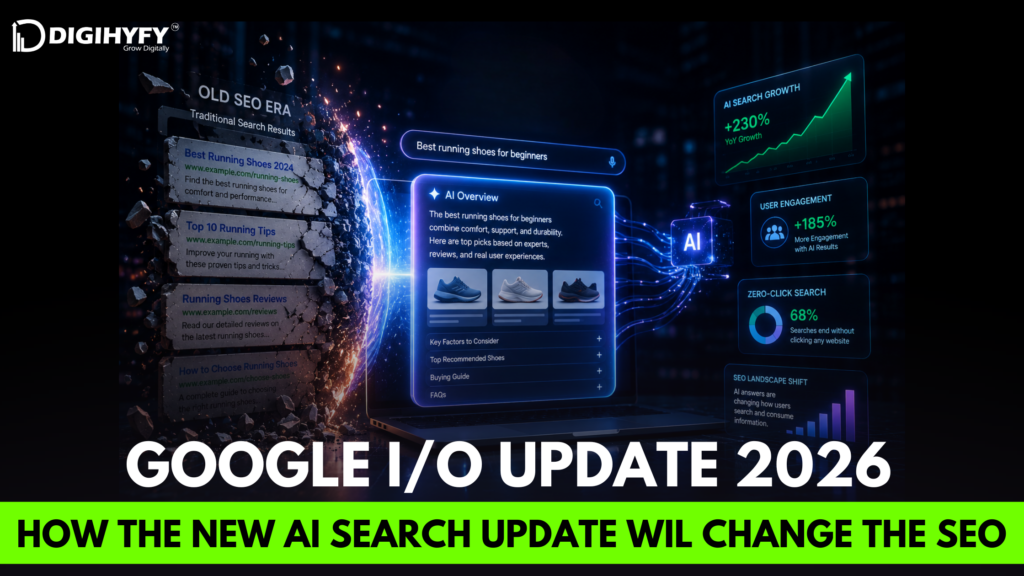
On May 19, 2026, Google announced the biggest change to its search box in over 25 years. If you run a website, write content, or manage SEO — this changes everything you thought you knew.
Google I/O 2026 was not just another annual developer conference. It was a turning point. Google’s head of Search, Liz Reid, took the stage and declared the search bar “completely reimagined with AI” — backed by Gemini 3.5 Flash, the company’s most capable and efficient model yet. For SEO professionals and content creators, the reaction ranged from cautious optimism to outright alarm.
TechCrunch summed it up bluntly in their headline: “Google Search as you know it is over.” That is not hyperbole. Here is what changed, what it means for organic traffic, and how you adapt.
What Google Announced at I/O 2026
The most striking announcement was a fully reimagined search box no longer just a place to type keywords. It now anticipates intent, offers suggestions that go far beyond autocomplete, and serves as an entry point into conversational AI experiences powered by Gemini 3.5 Flash.
But the bigger shift is the introduction of Information Agents. These are AI-driven agents that work on your behalf continuously scanning the web and sending you personalized, synthesized updates. Planning to move? Tell the agent your apartment requirements and it monitors listings for you. Want to track a sneaker collab from a favorite athlete? Your agent notifies you the moment a drop lands. These agents will first roll out to Google AI Pro and Ultra subscribers this summer.
AI Mode Google’s chatbot-format search experience has also crossed one billion monthly users, with queries more than doubling every quarter since launch. Google expanded it to nearly 200 countries and 98 languages, no subscription required. The era of ten blue links is not just fading it is being replaced by synthesized, agentic answers.
The Real Impact on Organic Traffic
The numbers are hard to ignore. AI Overviews now reduce organic click-through rates by anywhere from 15% to 46.7%, depending on the type of query. Position-one CTR on queries where AI features appear has dropped from 27% to as low as 11%. More than half of all search sessions in the US now end without a single outbound click — what the industry calls zero-click searches.
The financial impact is already showing up in corporate earnings. HubSpot has estimated organic traffic declines of 70–80%. Google’s own Network ad revenue (the money publishers earn through AdSense) fell 4% year-over-year in Q1 2026, even as Google’s own search revenue grew 19% to $60.4 billion. The platform is capturing more value — while sending less traffic downstream.
Key Insight
Being cited inside an AI Overview is now more commercially valuable than a first-page ranking. Brands cited in AI Overviews earn 35% more organic clicks and 91% more paid clicks compared to non-cited competitors on the same query.
How SEO Must Change in 2026
The old playbook: find a keyword, write an article, build backlinks still matters, but it is no longer enough on its own. The fundamental shift is this: SEO was about ranking for queries. AI search is about being selected as input into an answer.
- Optimize for AI Citation (GEO)
Generative Engine Optimization (GEO) is the new discipline alongside traditional SEO. The goal is not just to rank, it is to become the source that Google’s AI quotes, cites, and synthesizes. That means creating content with clear facts, original data, structured markup, and verifiable expertise that AI can easily extract and attribute.
- Build Entity Authority, Not Just Page Authority
AI Mode synthesizes across sources rather than picking a single ranking URL. Your brand, products, team members, and locations need consistent, accurate signals across the entire web, not just your own site. Structured data, Knowledge Panel accuracy, and third-party mentions all feed into how AI perceives your authority.
- Prioritize Original Research and First-Hand Expertise
The March 2026 Google Core Update hammered AI content farms and thin affiliate sites and many lost 60–80% of their traffic. What gained ground were sites with verified expertise, original analysis, transparent authorship, and content that genuinely answered questions better than any competitor. This is not a trend. It is the new baseline.
- Target Transactional Intent
Not all queries are equally affected. Informational queries trigger AI Overviews 39% of the time. E-commerce queries? Only 4%. Transactional and navigational content faces far lower AI Overview exposure. If your business model depends on clicks, shifting your content strategy toward purchase-intent and local service queries is a smart hedge.
Use structured schema markup (FAQ, HowTo, Article, Product) on every key page
Publish original research, surveys, or proprietary data that AI will want to cite
Build consistent brand signals across Google Business Profile, Wikipedia, and industry directories
Monitor Google Search Console for rising impressions with falling CTR that is the AI traffic drain in action
Focus long-form content on depth and unique perspective, not keyword density
Develop a content type that only your team can produce personal experience, original data, expert opinion
What This Means for Publishers and Businesses
Lily Ray, Vice President of SEO Strategy at Amsive, warned last year that Google’s changes would “severely cut into the main source of revenue for most publishers.” That prediction is proving accurate. Business Insider lost 55% of organic traffic over three years. CNN dropped 27–38%. Chegg sued Google directly over AI Overview impact.
However, the picture is not entirely bleak. Businesses that adapt fast building brand authority, earning AI citations, and creating genuinely useful content are finding new opportunities for visibility. Impressions are not dead. The brands cited inside AI answers are reaching more users than ever. The challenge is converting that visibility into action.
If your Google Search Console data shows impressions rising while clicks and CTR fall, you are already experiencing the shift. Google I/O 2026 did not start this transformation. It accelerated it significantly.
The Bottom Line
Google I/O 2026 confirmed what many SEOs suspected: the search engine you built your strategy around is being fundamentally rebuilt. AI Mode, Information Agents, and the reimagined search box represent a genuine structural change — not a passing algorithm tweak.
The websites that will thrive are those that publish quotable, verifiable, machine-readable expertise — consistently. Rankings will matter less. Trust, authority, and citability will matter more. The companies that adapt to this new reality in the next 12 months will define their category. Those that do not will find themselves invisible in a world where Google answers the question before the user ever reaches their site.
The rules changed. It is time to rewrite your playbook.