 +91 8981168001
 info@digihyfy.com

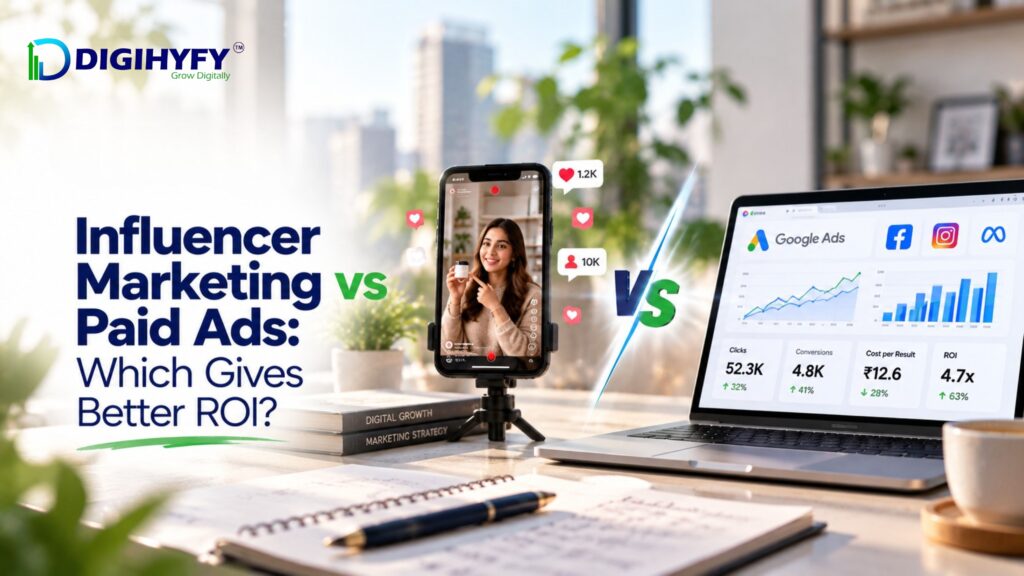
In the current digital world, all companies look for effective approaches that will help them connect with the audience, attract leads, and sell products. In this context, the two widely used methods are influencer marketing and paid ads. While both approaches allow increasing brand visibility and attracting clients, their effectiveness depends on the campaign objectives and budget.
However, what is more important to businesses is the following: Influencer Marketing vs Paid Ads – which gives higher ROI?
Let us see the differences and advantages and challenges of both strategies to find out which approach suits better.
What Is Influencer Marketing?
Influencer marketing entails working with content creators who have an existing following on channels like Instagram, YouTube, and Facebook. The content creators will market the products through reels, video clips, product reviews, tutorials, and sponsored posts.
The biggest strength of influencer marketing is the element of trust. Followers will appreciate the opinion of a content creator that they interact with consistently. Therefore, influencer marketing is suitable when seeking to create awareness about a brand, build credibility, and influence buying decisions.
For instance, a skincare company can work with a beauty influencer who will showcase the products of the company. The influencer will not be directly promoting the product but sharing the experience with a relevant audience.
Advantages of influencer marketing:
Establishes trust and builds brand credibility.
Targets a niche or highly relevant audience.
Creates engaging and shareable content.
Stimulates product discovery and generates social proof.
Helps establish lasting customer relationships.
On the other hand, success is not always assured. The wrong choice of influencer, irrelevant audience, and lack of conversion tracking may limit the success of a campaign.
What Are Paid Ads?
Paid advertising means paying the platform, like Google, Meta, and LinkedIn, to display promotional messages among their users. It includes running ads through search engines, display ads, video ads, and social media ads.
Paid advertising is more flexible than influencer marketing in terms of targeting, budgeting, placement, and analysis of the performance of the campaign. One can target people according to their interests, demographics, intentions, geographical location, and past behavior.
For instance, if one is working in real estate, then the firm can target people who are looking for commercial office spaces in Kolkata.
Benefits of paid advertising:
Gives immediate visibility and measurable results.
Enables targeting of precise audiences.
Provides flexibility for allocating budget.
Facilitates retargeting and lead generation.
Makes it easy to test various creatives and messaging.
But then, paid marketing is an ongoing process. The challenges of high competition, expensive clicks, bad landing pages, and poor targeting can lead to high costs of acquiring customers.
Which Strategy Offers Better ROI?
It depends on goals a business is trying to meet.
Influencer marketing will give better ROI when:
- Your business needs improved brand awareness.
- Your products require demonstration or recommendation.
- You need to build trust within the community.
- You can find a creator whose audience matches your target audience.
Paid advertising will give better ROI when:
- You need leads/sales in a certain time period.
- Your audience actively searches for your products/services.
- You need precise targeting and measurement of the performance of your campaign.
- You need to scale your successful campaign based on its performance data.
For instance, fashion brands launching a new collection can do well by collaborating with influencers to introduce their products to the audience. However, a B2B software company can get better results by using paid ads on LinkedIn or Google.
However, both approaches do not guarantee that one will perform better than another. The actual results will depend on the implementation of the strategy, the quality of the audience, pricing, conversion rates, and customer lifetime value.
Why Combining Both Strategies Can Work Better
Rather than opting for just one of them, companies may choose to integrate influencer marketing with paid ads for better results.
An influencer can develop genuine content and through that get the product introduced to new customers. And then the company can utilize the content provided by creators in their paid campaign as per requirements. They can also try retargeting the customers who have visited their website or have shown any interest in the brand.
This combination uses the authenticity of creator content and targeting abilities of paid ads.
Conclusion
These two have distinct differences and one cannot be considered better than the other from the point of view of ROI. Influencer marketing works well for gaining trust, awareness and establishing the brand image. On the other hand, paid advertising works great to target an audience and create leads.
It depends upon your goals, audience and budget as to which one works for you. However, by regularly analyzing the results of these techniques, the businesses can find out what suits them.