 +91 8981168001
  info@digihyfy.com
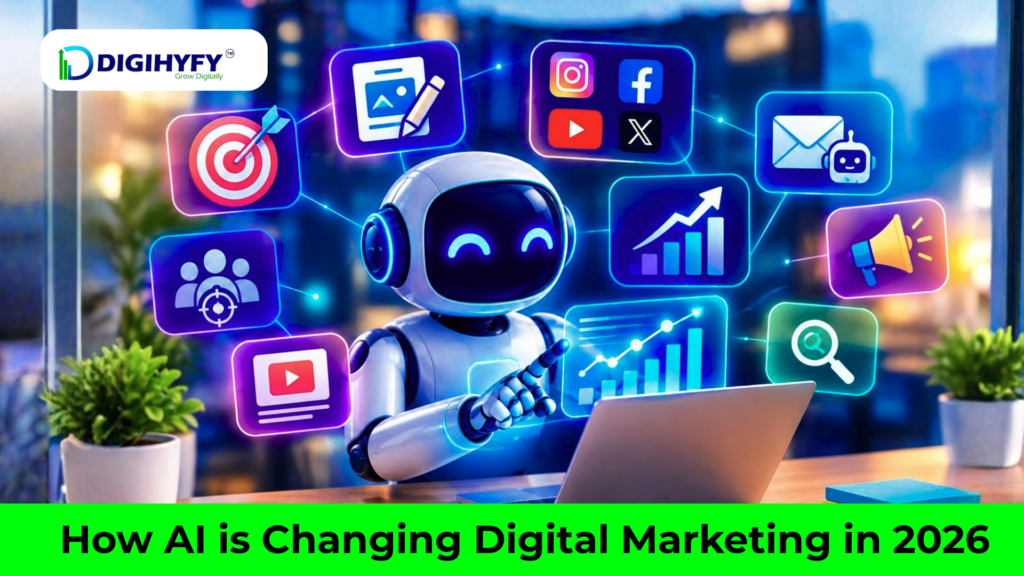
Artificial intelligence (AI) has transformed how companies market their products and services via digital platforms.
By 2026, AI has become an integral aspect of digital marketing. It aids businesses to enhance marketing activities and saves valuable time while reaching out to the right customers in a better way.
Previously, digital marketers used to spend hours finding keywords, developing ads, analyzing data, and managing campaigns. Now, AI-based tools help in doing all these activities more effectively.
But, human expertise and creative thinking are also needed in order to make marketing efforts successful.
In this blog post, we will discuss how AI is transforming digital marketing by 2026.
- AI-Powered Content Creation
Content is one of the critical elements of digital marketing. Companies require blogs, social media posts, website content, email marketing, and advertising to capture customers’ attention.
The use of AI in digital marketing enables marketers to come up with content ideas, make outlines, create the first draft of content, and even enhance already written content.
For instance, a digital marketing company can use AI to create content for their blog posts depending on the customer’s interests and industry news.
Nonetheless, AI-written content must always be reviewed and edited by humans. Companies should concentrate on making original and valuable content.
- The Future of SEO with AI
Search Engine Optimisation (SEO) is also transforming due to AI. Search engines are becoming more sophisticated in comprehending the query and delivering responses to their users.
By 2026, businesses will have to take into account search intent, good quality content, experience and topical expertise. Using AI technologies, marketers can learn how to use keywords, study competitors, find content gaps and optimisation possibilities.
With AI search experiences becoming available, the provision of credible data by brands becomes necessary to appear in the search results and AI-driven responses.
Rather than concentrating solely on rankings of specific keywords, businesses will have to concentrate on answering customers’ questions.
- Personalised Marketing Experiences
Customers expect companies to know about their requirements and preferences. It is easier for them to personalize their experience through AI analysis of customers’ interaction history, browsing, and purchase history.
For instance, a web store can offer a particular product according to customer interest preferences. Likewise, email marketing campaigns can have varying messages for different segments of customers.
Nonetheless, marketers need to respect privacy and use data ethically.
- Smarter Social Media Marketing
Social media websites are very competitive. Organizations must have consistent content, creative content creators, and proper advertisement strategies to be unique.
AI applications can help marketers come up with ideas for content, analyze engagement, discover the preference of their customers, and produce various versions of advertisements.
AI may also be used in scheduling posts, tracking brand mentions, and giving summary reports on the performance of marketing campaigns.
A good example of how AI can be applied is where an organization dealing with real estate can use AI to come up with ideas for social media content and advertisement campaigns.
- AI in Digital Advertising
AI technology is increasing the role of data in online advertising. Ad platforms are currently implementing machine learning in order to target audiences, automate bidding, manage budgets, and optimise campaigns.
By 2026, marketers will be able to utilise AI-enhanced tools for testing various headlines, images, and calls-to-action and gain information about the performance of advertisements.
For instance, an entrepreneur operating Google Ads can automate his bids and use conversion tracking to enhance the performance of the campaigns.
Nevertheless, automation does not necessarily bring success. A company should have specific objectives, track expenses, conduct proper tracking and evaluate the campaign performance.
- AI Chatbots and Customer Support
AI chatbots are now aiding firms in their interactions with customers 24/7. They can help in answering common queries, service descriptions, enquiries, and directing customers to the right product offerings.
For instance, a digital marketing company can have a chatbot that answers queries related to SEO services, pricing, and other details.
Such an approach will ensure quick responses and allow salespeople to pay more attention to difficult queries.
Customers must still be given an opportunity to speak with human agents for difficult or confidential queries.
- Predictive Analytics and Better Decisions
AI is capable of analysing huge volumes of marketing data and drawing conclusions on patterns which might be hard to identify manually. This may allow for better understanding of the customer’s behavior, assessment of demand and even identification of target audiences.
Predictive analytics may be used by companies for planning campaigns, customer retention and allocation of marketing budget.
It is worth mentioning that predictions may be inaccurate sometimes. Marketers have to compare AI conclusions with real results of campaigns.
- Challenges of Using AI in Digital Marketing
However, while AI brings many advantages, it is not without problems. The use of AI may generate errors, repetitions, and prejudices. Excessive reliance on automated systems may also limit originality and erode relations with clients.
It is essential that businesses safeguard personal data, check facts, analyze AI output, and adhere to applicable laws on privacy and advertising.
The perfect strategy is the fusion of AI with human ingenuity and reasoning.
Conclusion
The following ways are how AI is shaping digital marketing in the year 2026: creation of content, SEO, management of social media, advertising, customer service, and data analysis. Companies that implement the technology properly would be able to gain more time, get better insights about their audience, and make better decisions regarding marketing. However, there are other factors for the success apart from technology.
Human creativity, credibility, good content, and customers’ relations are all vital.