 +91 8981168001
  info@digihyfy.com
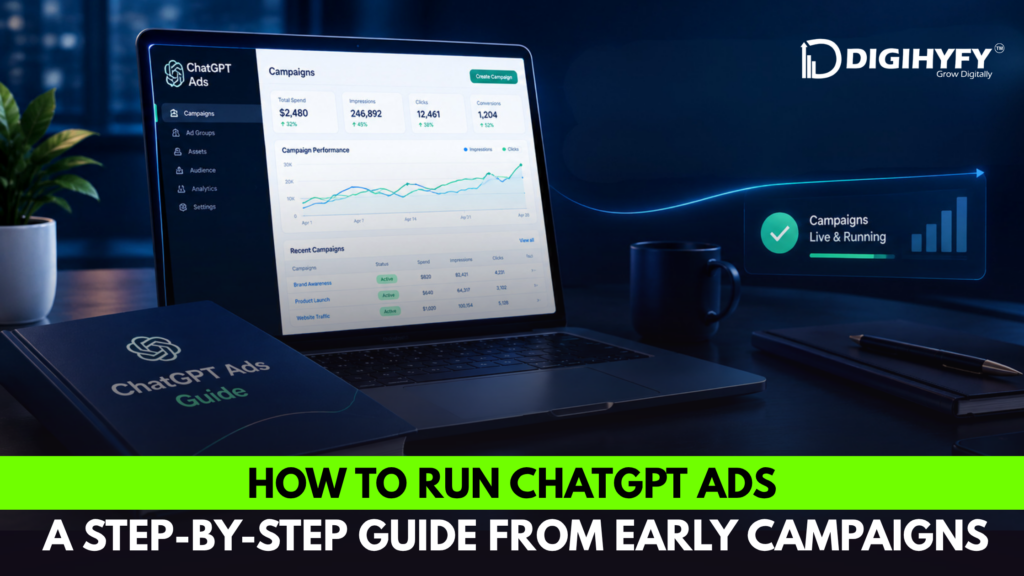
AI is disrupting product discovery and decision-making processes among consumers. Since ChatGPT is part of this process, advertising through the platform is one way for companies to tap into the research that is taking place among its users.
This ChatGPT Ads guide takes you through the workings of ChatGPT Ads, the process of launching your first ad campaign, and insights that come from launching your first campaign.
What Are ChatGPT Ads?
ChatGPT Ads: These are sponsored ads which can be shown below ChatGPT replies. Such ads are clearly marked and are completely separated from the AI reply. Format of such ads can include Advertiser Name, Headline, Description, Image, and Landing Page.
ChatGPT Advertising differs significantly from regular search ads by its nature. While in regular search advertising exact keyword match is used, ChatGPT advertising takes into account the following elements: conversational context, user intent, ad copy, landing page and provided advertiser context hints.
This makes relevance crucial.
Step 1: Set Up Your Ads Manager Account
The first task will involve the creation of an account using the OpenAI Ads Manager. Based on the OpenAI quickstart guide for advertisers, one has to sign into an OpenAI account, set up brand information, billing and payments information, and complete the necessary verification process.
After setting up an account, you can start creating your ads campaigns.
Step 2: Choose Your Campaign Objective
The campaign goal must align with your business goal.
Current choices offered by OpenAI are as follows:
- Views: Intended for gaining visibility and exposure.
- Clicks: Intended for getting traffic directed to your site or product.
- Conversions: Intended for optimizing delivery toward a conversion event
Campaigns have two budget types available, which are daily and overall campaign budgets. The daily budget will be helpful for those advertisers who have started using the platform for the very first time.
Do not select any goal just because it looks appealing. Choose the metric which is more relevant to your marketing goal.
Step 3: Build Focused Ad Groups
Ad groups aid in organizing advertisements around one specific product, service, audience requirement, or use case.
As an example, a digital marketing agency can create ad groups for:
- SEO services
- PPC services
- Content marketing
- Local SEO
Even OpenAI enables advertisers to include context clues. These give an insight into scenarios when an advertisement can be appropriate. However, unlike exact-match keywords, context clues are not regular exact-match keywords that would ensure that the advertisement will show up during a certain conversation.
Instead of thinking of keywords, think of the questions your prospective customers will be asking.
Step 4: Create Multiple Ad Variations
OpenAI advises that advertisers opt for benefit-oriented advertising by highlighting what the product does, whom it is designed for, and why it could be beneficial within a very brief period of time. It is also advisable to make several variations and not repeat the message again and again.
Instead of coming up with five headlines which would be alike, try to experiment with the benefits, uses, and customer problems.
The landing page must live up to the promise made in the ad because otherwise it might negatively affect the overall user experience.
Step 5: Set Your Budget and Launch
When all aspects of your campaign such as the ad groups, the ads, the target audience, and the landing pages are ready, then you may submit your campaign for approval.
Previous campaigns mentioned by industry analysis have proven that ChatGPT Ads are distinct from other forms of advertising systems since the system is new and the advertisers are discovering the effects of conversational intent on delivery and performance.
The present OpenAI platform allows for buying based on impressions and clicks as well as conversions for some eligible campaigns.
Begin with a small budget rather than a large one.
Step 6: Measure and Optimize Performance
The campaign launch is just the start. Track impressions, clicks, CTR, average CPC, CPM, cost, and conversions for the ads you’ve got conversion tracking set up for. OpenAI gives these reporting tools in Ads Manager.
Utilize the initial data you collect to find out:
- What ad copy works to click
- What ad groups create real engagement
- What landing pages convert
- If your audience targeting is relevant
- Where your money is getting spent effectively
Use UTM parameters for your landing page links so that you can track the traffic coming from ChatGPT in your own analytics tool as well.
Conclusion
ChatGPT advertising differs from traditional keyword-based advertising by the nature of the environment where conversations and user intent prevail. The best strategy to implement is to start with a focused campaign, context clues, several valuable creative versions, and achievable conversion goals.
From experience with early campaigns, it is evident that companies need to treat ChatGPT Ads as a place for experimenting rather than using Google Ads and Meta Ads experience directly. With time, those businesses that will be able to continuously analyze their data and improve their approach will have a better idea of how things work.
This ChatGPT advertising guide offers an effective way to enter the world of AI-native advertising – determine the objective, organize ad groups, make valuable ads, invest money wisely, test performance, and optimize results.
Lorem ipsum dolor sit amet, consectetur adipiscing elit. Ut elit tellus, luctus nec ullamcorper mattis, pulvinar dapibus leo.