
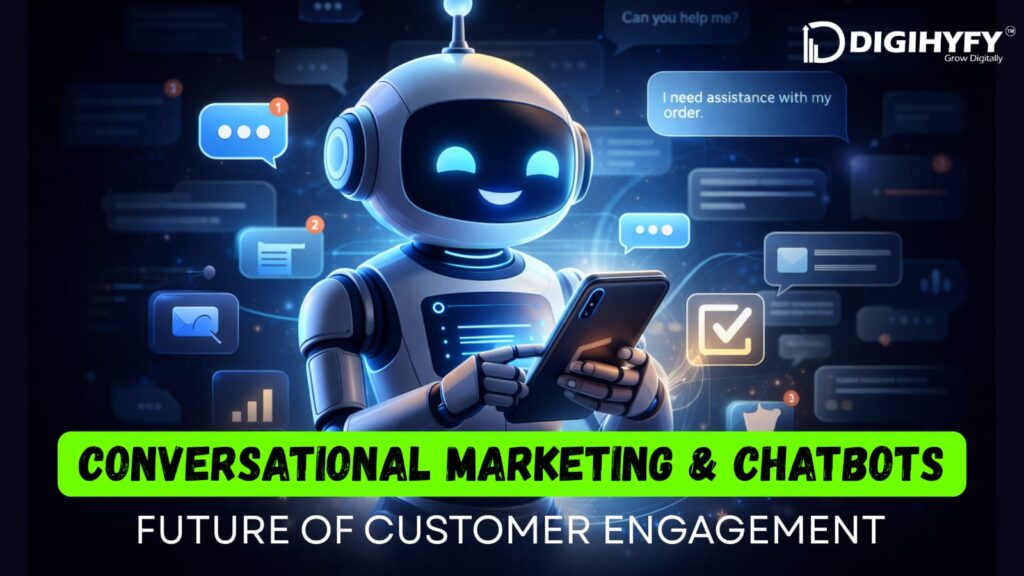
In the present era, consumers expect instantaneous communication which should be tailored and seamless at the same time. Traditional modes of communication such as email, online advertisement etc. are not sufficient in engaging consumers. It is here where conversational marketing and chatbots have revolutionized the way businesses communicate with their consumers. By enabling instant interaction with consumers, the process becomes personal and much more effective.
What is Conversational Marketing?
Conversational marketing can be defined as a type of marketing which relies upon one-on-one engagement with consumers. Rather than waiting for consumers to submit forms or communicate through emails, organizations adopt the use of live chats and messaging bots to communicate with consumers.
Platforms such as messaging apps, websites, and social media channels enable brands to interact directly with their audience. This approach improves user experience and builds trust faster.
Role of Chatbots in Modern Marketing
Chatbots are AI-powered tools that simulate human conversation. They can answer queries, guide users, recommend products, and even complete transactions. Unlike human agents, chatbots are available 24/7, ensuring customers get instant support anytime.
Advanced chatbots use technologies like Natural Language Processing (NLP) to understand customer intent and respond accurately. This makes conversations more natural and less robotic.
Advantages of Conversational Marketing and Chatbots
- Immediate Customer Service
No more waiting in long queues for hours. The chatbot offers immediate service, which ensures greater customer satisfaction.
- Tailored Experience
The chatbot can analyze user behavior and tailor its responses according to their needs, which makes customers feel important.
- Improved Conversion Rate
Instant communication will help in guiding the customer towards a successful purchase.
- Effective and Cost-Effective Solution
Automation of processes will lead to savings in labor costs.
- Lead Collection and Qualification
The chatbot can collect all user data and send qualified leads to the sales team.
How Conversational Marketing Functions
Conversational marketing involves interacting with customers throughout their buying process:
- At the Awareness Stage, chatbots welcome customers and give them information.
- At the Consideration Stage, chatbots address questions and suggest remedies.
- At the Decision Stage, chatbots help customers purchase and give them support.
Popular Tools for Conversational Marketing
Many companies employ software such as Drift, Intercom, and HubSpot to adopt conversational strategies. Such software includes live chat, automation, analytics, and the integration of customer relationship management (CRM) systems.
Future Trends in Chatbots and Conversational Marketing
The following are future trends in chatbots and conversational marketing:
- Artificial Intelligence (AI)-Based Personalization
Chatbots will become more advanced and personalize their communication according to the actions of users.
- Voice Communication
In the future, as the usage of voice assistants grows, conversational marketing will evolve to incorporate voice-based communication.
- Multi-channel Integration
In the future, businesses will integrate their chatbots into multiple channels such as web pages, WhatsApp, Instagram, and others.
- Hybrid Chatbots and Human Agents
While chatbots will answer routine inquiries, human agents will address complicated concerns.
Challenges to Consider
Even though there are several benefits of chatbots, some challenges need to be considered:
- Limited ability to understand complicated situations
- Absence of emotional intelligence
- Improper use can cause frustration to users
To resolve this problem, corporations have to continuously improve their chatbot applications.
Conclusion
As it was mentioned above, conversational marketing and bots are more than just a trend; they are a future direction of development for enterprises. Conversational marketing allows companies to build stronger relations with consumers and make interactions between a client and a company easier and faster.
In a modern world, where customers expect immediate reactions from organizations, conversational marketing plays a crucial role in business performance.